
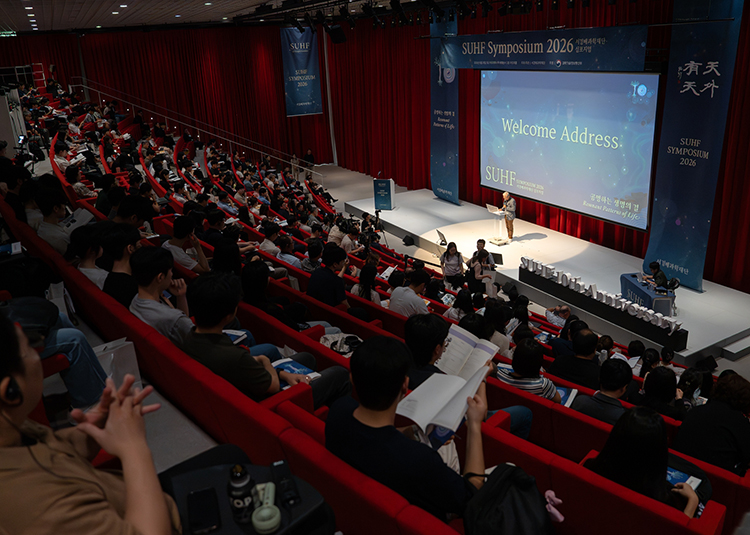
The Suh Kyungbae Foundation (Chairman Suh Kyungbae) held the SUHF Symposium 2026 on August 29 at the Amorepacific Global Headquarters in Yongsan-gu, Seoul.
The Suh Kyungbae Foundation is a public interest foundation established in 2016 by Amorepacific Group Chairman Suh Kyungbae with an endowment of KRW 300 billion from his personal assets. Over the past 10 years, the foundation has selected and funded early-career researchers in the life sciences annually, working to build an environment where scientists can focus on long-term, innovative research. Held annually since 2020, the SUHF Symposium serves as a stage where the foundation's researchers publicly present their research accomplishments over the past five years. It introduces the latest discoveries in the life sciences in accessible language, providing a venue where researchers can answer audience questions directly and share new knowledge with the wider world.
Organized by the foundation and sponsored by the Ministry of Science and ICT, this year's symposium was held under the theme of "Resonant Patterns of Life." Organized to commemorate the 10th anniversary of the foundation's establishment, the symposium opened with a keynote lecture by Professor Michael Hall of the University of Basel in Switzerland, the discoverer of TOR, a central signaling pathway that links nutrient sensing to cell growth control. This was followed by a graduate discussion, a special lecture by Professor Jeong Ho Lee (KAIST Graduate School of Medical Science and Engineering / CSO of SoVarGen)—selected for foundation's first Young Investigator Program cohort—and poster sessions, where emerging scientists selected in 2021 presented the outcomes of their five-year research projects funded by the foundation.
△ Professor Youbong Hyun (School of Biological Sciences, Seoul National University) presented research on the theme, "Innovations in Water Use for Plant Reproduction in Motion". His team elucidated the principle by which violets disperse seeds over long distances without external aid through moisture changes in the fruit pod. He also explained how xylem vessel occlusion observed in violets can be applied to diverse areas, including plant infection prevention and fruit ripening.
△ Professor Taeyun Ku (KAIST Graduate School of Medical Science and Engineering) presented on "New Vistas on the Unseen in Biology," introducing various visualization technologies developed and utilized in his laboratory. He addressed the importance of observation in understanding biological phenomena and the technical approaches that enable it, ranging from methods that alter specimen shapes for effective dye penetration to extracting new data from conventional medical imaging and precisely observing brain neural networks with limited resources.
△ Professor Hanseul Yang (Department of Biological Sciences, KAIST) introduced tissue regeneration research using African spiny mice under the title, "A Comparative Study Deciphering the Key Principles of Scar-free and Complete Skin Regeneration in Mammals". The African spiny mouse is an animal capable of healing skin injuries back to their pre-damaged state without leaving scars. His team is investigating the mechanisms of skin regeneration by analyzing the spiny mouse's recovery capacity across multiple domains, including skin architecture and cellular stress tolerance.
In the special lecture, Professor Jeong Ho Lee (KAIST Graduate School of Medical Science and Engineering / CSO of SoVarGen) presented his research on brain somatic mosaicism, which he has conducted over the past 10 years with the foundation's support as a first-cohort Young Investigator. He explained the impact of brain somatic mosaicism on various neurological conditions, including neurodegenerative diseases, and outlined possibilities for developing new therapies using these findings.
Chairman Suh Kyungbae stated, "For the past 10 years, the Suh Kyungbae Foundation has worked to foster an environment where young scientists can take on new challenges without limits, conducting more in-depth research and building broader connections under the philosophy of 'There is an infinite sky beyond the visible one' (天外有天)." He added, "The Suh Kyungbae Foundation will continue to trust in the boundless possibilities of science and sustain its efforts to turn those possibilities into reality."
The symposium was attended by approximately 300 people, including life science researchers, high school students, educators, and corporate researchers. In addition to Amore Hall, the main event hall, a poster session by active researchers was held on the third floor of the Amorepacific Global Headquarters, along with various programs organized for general attendees.